Want to be in the loop?
subscribe to
our notification
Business News
VIETNAM EYES US$550-BILLION EXPORT TARGET AMIDST PRESSURE FOR HIGHER VALUE-ADDED GROWTH
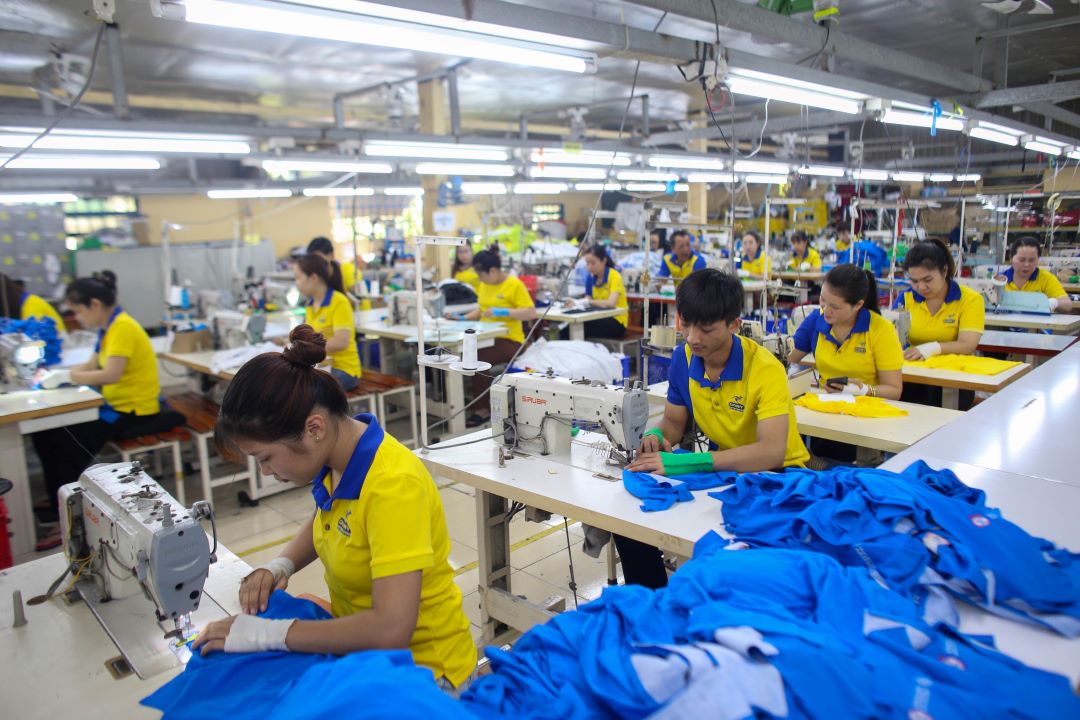
Post-Tet production surges as factories restart operations to fulfill new export orders. PHOTO: LH
HCMC – To achieve the ambitious export target for 2026, Vietnam must maintain average monthly revenue of US$45-46 billion, a feat that requires an urgent shift from volume-based growth to higher value-added strategies.
This demand comes as factories nationwide rapidly reactivate production lines post-Tet to meet a steady flow of orders, even as global market uncertainties and rising costs squeeze profit margins.
Order books are filling up through the second quarter of this year for key sectors like garments, footwear and furniture, the level of certainty remains fragile. But many manufacturers report that lead times for order confirmations have shortened significantly as global buyers maintain a cautious stance. In the textile industry, firms are increasingly balancing traditional Free on Board (FOB) contracts with cut-make-trim (CMT) services to stabilize cash flow and maintain employment, even at lower profit margins.
Despite a positive Purchasing Managers’ Index (PMI) of 52.5 in January, indicating the seventh consecutive month of expansion, the sector faces a paradox. Export volumes rise but profitability shrinks due to a 5% decline in order prices alongside rising labor and logistics costs.
The current growth model, heavily reliant on low-cost advantages and raw exports, is reaching its limits. Major export sectors like electronics remain dominated by foreign direct investment (FDI), while domestic firms are often confined to assembly and low-value processing. This structural imbalance limits the spillover effects of export growth on the local economy.
Furthermore, increasingly stringent global standards regarding carbon emissions, traceability, and labor rights are driving up compliance costs, forcing enterprises to either invest in technological upgrades or risk losing market share.
To sustainably reach the US$550-billion milestone, Vietnam’s export sector must restructure its approach by increasing localization rates, developing supporting industries, and investing in deep processing and branding. Experts emphasize that the true significance of this target lies not just in the gross turnover, but in the ability of Vietnamese enterprises to retain a larger share of value within the domestic economy. Shifting from a cost-driven to a value-driven model is now a prerequisite for Vietnam to maintain its competitive edge in a global trade environment that increasingly prioritizes quality and technology over scale.
Source: The Saigon Times
Related News
INFRASTRUCTURE / CONSTRUCTION / LOGISTIC / PORT
HUNG YEN BUILDS MOMENTUM FOR DOUBLE-DIGIT GROWTH WITH STRONG H1 PERFORMANCE
Strong industrial output, rising investment and robust trade propelled Hung Yen into Vietnam's top five fastest-growing localities in the first half of 2026, reinforcing confidence in the province's double-digit growth outlook. Accordingly, the Northern province posted regional GDP growth of 10.7 per cent in the first half (H1) of 2026, outperforming its growth target and ranking among Vietnam's five fastest-growing localities.

GARMENT / TEXTILE
FOOTWEAR INDUSTRY ACCELERATES GREEN TRANSITION, STRENGTHENS SUPPLY CHAINS
Việt Nam's footwear industry is stepping up efforts to build greener production and strengthen domestic supply chains as it seeks to maintain export growth amid global uncertainties. The sector earned nearly US$12 billion from exports in the first half of 2026. During the period, Việt Nam also overtook China to become the largest footwear supplier to the US market for the first time.
VIETNAM ECONOMY INVESTMENT
GROWTH RACE BEGINS TURNING PROVINCES INTO NEW ECONOMIC ENGINES
A new growth race is taking shape across Việt Nam, but this time it is not just about which province expands the fastest. The latest gross regional domestic product (GRDP) figures reveal a deeper shift in the way the country is managing its economy, with localities increasingly expected to become independent growth engines rather than simply implementing centrally assigned policies.

VIETNAM ECONOMY INVESTMENT
TRADE BUDGET REVENUE NEARS VND265 TRILLION, DRIVEN BY CUSTOMS REFORM
Budget revenue from Vietnam's import-export activities reached VND264.795 trillion (US$10.59 billion) in the first six months of 2026, up 18.6% from the same period last year. The result reflects not only the strong recovery in trade but also progress in institutional reform, administrative simplification, and digital transformation across the customs sector, helping reduce compliance costs, improve competitiveness, and facilitate trade for businesses.

INFRASTRUCTURE / CONSTRUCTION / LOGISTIC / PORT
VIỆT NAM UPGRADES SEAPORT NETWORK TO STRENGTHEN MARITIME COMPETITIVENESS
Hải Phòng City has emerged as one of Việt Nam's key logistics hubs thanks to an integrated transport network combining expressways, an international airport, a planned high-speed railway and a deep-water port capable of handling vessels of more than 200,000 deadweight tonnages (DWT) with direct connections to Europe and the Americas.

INFRASTRUCTURE / CONSTRUCTION / LOGISTIC / PORT
KHÁNH HÒA CALLS FOR INVESTMENT IN PORTS, LOGISTICS
At an investment promotion conference held on July 14, Trương Văn Tiến, director of the provincial Investment, Trade and Tourism Promotion Centre highlighted the strategic advantages of the Vân Phong deep-water port and Cà Ná port, saying the facilities would underpin the development of port services, logistics, shipbuilding, energy and other marine-based industries.
Events Sponsors


