Want to be in the loop?
subscribe to
our notification
Business News
FOOTWEAR INDUSTRY ACCELERATES GREEN TRANSITION, STRENGTHENS SUPPLY CHAINS
Lefaso has called for faster development of the domestic supporting industry to reduce reliance on imported materials. It also proposed establishing strategic raw material reserves and trading platforms to improve supply security.
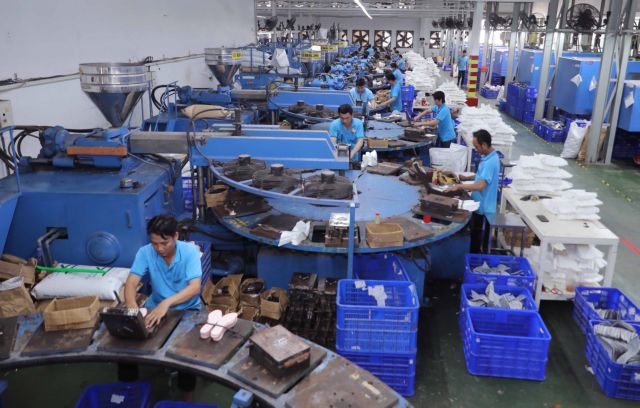
A shoes production line at Viễn Thịnh Shoes Company in Long Hậu Industrial Zone in southern province of Tây Ninh. Việt Nam is currently the world's third-largest footwear producer, after China and India, and the second-largest exporter.— VNA/VNS Photo
HÀ NỘI — Việt Nam's footwear industry is stepping up efforts to build greener production and strengthen domestic supply chains as it seeks to maintain export growth amid global uncertainties.
The sector earned nearly US$12 billion from exports in the first half of 2026. During the period, Việt Nam also overtook China to become the largest footwear supplier to the US market for the first time.
Footwear exports reached $11.95 billion during the first six months of the year, up 0.5 per cent from a year earlier. Although shipments to markets such as China, Japan, the UK and Mexico declined, exports recovered strongly toward the end of the second quarter.
In June alone, overseas shipments rose to $ 2.16 billion, more than $200 million higher than in May, supported by strong demand from the US and the EU, statistics show.
The US remained Việt Nam's largest export market, accounting for nearly 39 per cent of the industry's total export value with shipments worth an estimated $4.55 billion during the year's first half, up more than 6 per cent year-on-year.
Việt Nam is currently the world's third-largest footwear producer, after China and India, and the second-largest exporter. Around 90 per cent of its footwear production is sold overseas.
However, the industry's heavy dependence on exports also makes it vulnerable to external shocks. Experts say geopolitical tensions, rising logistics costs and increasingly strict trade policies in major markets are putting pressure on manufacturers.
Dr Võ Trí Thành, President of the Institute for Brand and Competitiveness Strategy, pointed out that businesses are facing both supply chain disruptions caused by geopolitical conflicts in the Middle East and growing trade protection measures in the US.
Raw materials account for 60–65% of the cost of producing a pair of shoes. Facts in the second quarter showed that companies with sufficient inventories were better able to cope with higher logistics costs to deliver orders on time, while many smaller firms had to reject export orders because they lacked materials.
To strengthen competitiveness, the Vietnam Leather, Footwear and Handbag Association (Lefaso) has called for faster development of the domestic supporting industry to reduce reliance on imported materials. It also proposed establishing strategic raw material reserves and trading platforms to improve supply security.
The industry is also accelerating its green transition to meet stricter sustainability requirements, particularly in the EU, including carbon reduction, product traceability and Digital Product Passport regulations, according to Lefaso Vice Chairwoman and General Secretary Phan Thi Thanh Xuan.
Since the second quarter, many large manufacturers have increased investment in clean technologies, automation, digital transformation and environmentally friendly materials. At the same time, companies are shifting from contract manufacturing to original design and brand development while leveraging the 17 free trade agreements Vietnam has signed to expand into new markets such as India, the Middle East and Africa.
Lefaso said maintaining a skilled workforce also remains essential, adding that stronger supply chain resilience will be key to helping Vietnam preserve its position in the global footwear market. — VNS
Source: VNS
Related News

CHARITY / EXHIBITION / OTHER EVENTS
INVESTMENT OPPORTUNITIES IN CA MAU PROVINCE: 96 PROJECTS AND 20 STRATEGIC PROJECTS
We are pleased to share with you information on investment projects currently seeking investors in Ca Mau Province. Should your esteemed company or association be interested, we kindly invite you to review the project information and complete the registration form via the links provided. The Ho Chi Minh City Investment and Trade Promotion Centre (ITPC) will consolidate the expressions of interest and facilitate connections with the leadership of Ca Mau Province at a meeting tentatively scheduled for 13 November 2026 in Ho Chi Minh City.

MEMBER CORNER / PROMOTIONS
BẰNG KIỀU LIVESHOW - A SYMPHONY OF LOVE UNDER THE GOLDEN GLOW
A masterclass in live music that takes the audience on a soulful journey through immortal love songs, guided by the peerless artistry and emotive storytelling of renowned singer Bằng Kiều. The highlight of the night is his seamless musical chemistry with special guest Triệu Hồng Ngọc, promising passionate and deeply resonant duets inside the magnificent Grand Ballroom.

INFRASTRUCTURE / CONSTRUCTION / LOGISTIC / PORT
ĐÀ NẴNG GREEN-LIGHTS US$105 MILLION THAI DEVELOPMENT DEAL
The central city has approved an investment proposal by Thailand’s WHA Group to develop infrastructure for the 400ha WHA Đà Nẵng Industrial Park project on two communes of Thăng Bình and Đồng Dương, with an investment of more than VNĐ2.7 trillion (US$105 million). The city said it approved WHA Industrial Development International's status as an investor in the project, which is expected to take place between 2027 and 2034.

VIETNAM ECONOMY INVESTMENT
MOBILE PHONE EXPORTS RISE 20% TO $51.8 BILLION IN FIRST NINE MONTHS
Exports of mobile phones and components rose 20 per cent year-on-year to nearly US$51.8 billion in the first nine months of 2026, with China, the US and Republic of Korea accounting for more than half of the total. Shipments to the three markets reached a combined $26.18 billion, or 50.6 per cent of total exports of the product group during the period, according to data from the Vietnam Department of Customs under the Ministry of Finance.

INFRASTRUCTURE / CONSTRUCTION / LOGISTIC / PORT
VIỆT NAM-CAMBODIA TRADE GATHERS PACE TOWARDS $20 BILLION TARGET
Trade between Việt Nam and Cambodia continues to grow, remaining a bright spot and a key pillar of bilateral cooperation as the two countries aim to raise two-way trade to US$20 billion in the coming years. After setting a record of more than $11.3 billion last year, bilateral trade reached about $8.7 billion in the first eight months of this year, up 8.3 per cent year on year.

VIETNAM ECONOMY INVESTMENT
FRUIT AND VEGETABLE EXPORTS POISED TO HIT $10 BILLION IN 2026
Fruit and vegetable exports are on track to reach nearly US$10 billion in 2026, after rising 19.9 per cent year on year to nearly US$7.4 billion in the first nine months, driven by strong seasonal demand and abundant tropical fruit supplies. The Ministry of Agriculture and Environment said the growth reflected stronger international demand for fresh produce and processed agricultural products.
Events Sponsors






















