Want to be in the loop?
subscribe to
our notification
Business News
PHU THO SHARPENS STRATEGY TO ATTRACT NEXT-GENERATION INVESTMENT
Phu Tho is reshaping its investment promotion strategy with a greater focus on targeted investor engagement, business support, and digital transformation, as competition for high-quality investment among localities intensifies.
Prime Minister Le Minh Hung chaired a working session on July 14 with the Standing Committee of Phu Tho Party Committee to review the province's socioeconomic performance, double-digit growth target, public investment disbursement, implementation of the two-tier local government model, and progress on Politburo Resolution No.57-NQ/TW on science, technology, innovation, and national digital transformation.
The meeting came amid strong economic momentum. Phu Tho's regional GDP grew close to 11 per cent in the second quarter and almost 10.2 per cent in the first half of 2026 – the highest in the Northern Midlands and Mountainous Region and the seventh strongest among Vietnam's 34 provinces and centrally governed cities.
Industrial production rose just over 25 per cent on-year, while state budget revenue reached $1.39 billion in the first six months, up 21.5 per cent on-year and equivalent to 61.2 per cent of the annual target. As of July 3, public investment disbursement had reached 37.3 per cent of the annual plan, outperforming the national average.
The province also emerged as one of Vietnam's strongest destinations for overseas investment, attracting more than $1.77 billion in registered foreign investment during the first half, almost five times higher than a year earlier and already exceeding its annual target by more than 10 per cent.
Alongside economic growth, Phu Tho has identified tech-led innovation and digital transformation as strategic drivers of long-term competitiveness under Resolution 57. The province was among the first three localities nationwide to complete all assigned tasks on the resolution's implementation monitoring system, while continuing to expand digital infrastructure through three data centres.
Against this backdrop, Phu Tho is reshaping its investment promotion strategy. The first half of 2026 marked the inaugural operating period of the Phu Tho Investment Promotion and Enterprise Support Centre under its new organisational model, with a stronger focus on connecting investors with government agencies and supporting projects throughout their implementation.
According to the province's six-month performance report, released in early July, the centre's priorities include developing a pipeline of projects for 2026 and beyond, proposing policies to attract next-generation foreign investment, and strengthening linkages between local enterprises and foreign-invested companies to deepen their participation in global supply chains.
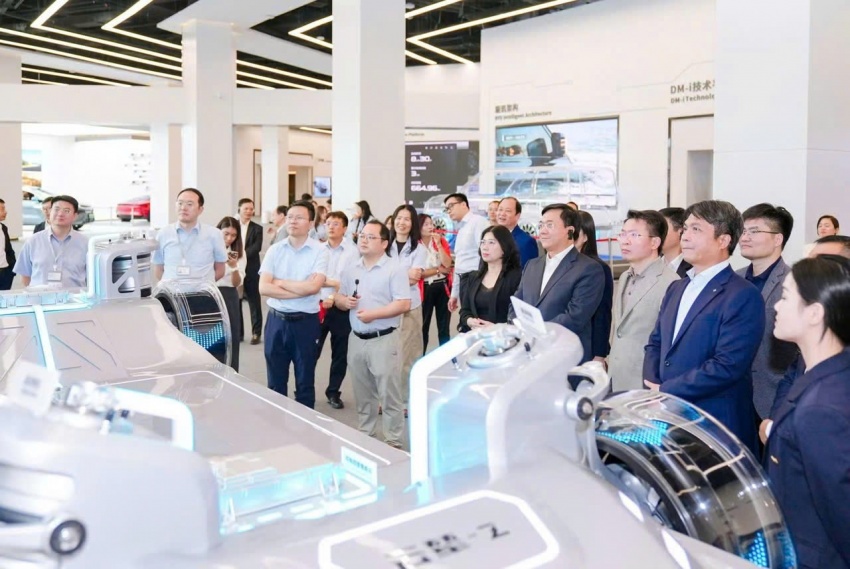
Tran Duy Dong, Chairman of Phu Tho People's Committee, and provincial delegation members visit a Geely Holding Group showroom during a working visit
The province has also intensified direct engagement with strategic investors. During the first half of the year, provincial leaders held discussions with major corporations including YCH Singapore, Meiko, Central Retail, MM Mega Market, Eurowindow, and Stavian, while welcoming site visits from investors such as Toyota Vietnam, Viettel Post, and businesses from Japan, South Korea, and China. International outreach has also accelerated, with investment promotion missions to China, Spain, Finland, and Sweden during the first half, alongside an investment promotion conference in Ho Chi Minh City in late May.
Speaking at the event, Tran Duy Dong, Chairman of Phu Tho People's Committee, said the conference provided an important opportunity to present the province's long-term development vision to the business community.
"By 2030, Phu Tho aims to become one of the Capital Region's key growth poles and a major centre for industry, trade, and logistics. Looking ahead to 2045, we aspire to become a centrally governed city with modern infrastructure and a prosperous economy," Chairman Dong said.
Investment promotion has also been strengthened through strategic partnerships. During the first half of the year, Phu Tho People's Committee signed cooperation agreements with Toyota Vietnam and Imarket Korea, while the Investment Promotion and Enterprise Support Centre concluded MoUs with Central Retail Vietnam, MM Mega Market Vietnam, Nafoods Group, Lee & Ko Vietnam, and several partners from South Korea and China, laying the groundwork for future investment projects across priority sectors.
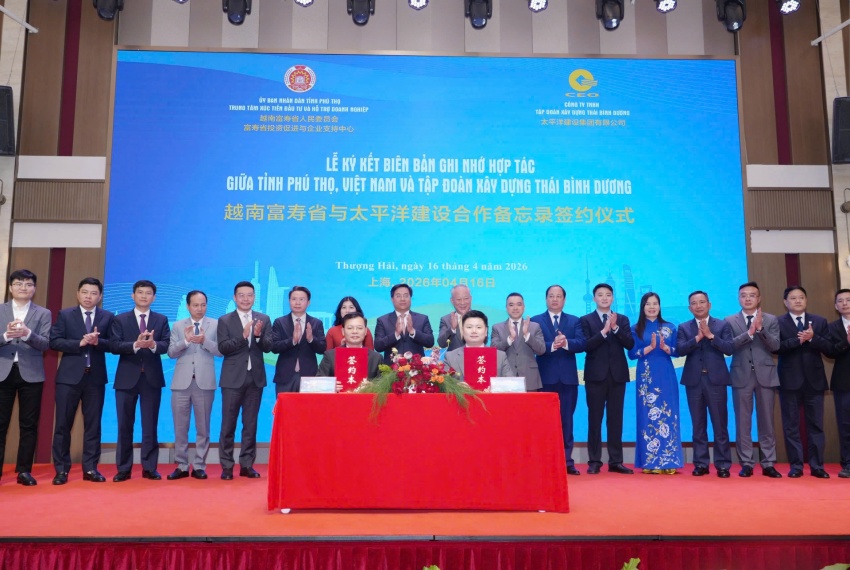
Representatives of the Phu Tho Investment Promotion and Enterprise Support Centre and China's Pacific Construction Group signing an MoU
While attracting new investment remains a priority, Phu Tho is placing increasing emphasis on investor aftercare, recognising that an efficient business environment has become as important as investment incentives in influencing business decisions.
During the first half of 2026, the Phu Tho Investment Promotion and Enterprise Support Centre consolidated 22 groups of recommendations from businesses and investors for submission to the provincial People's Committee, providing the basis for targeted policy responses. The province also continued resolving issues raised through previous business dialogues, addressing 53 of 69 outstanding recommendations, equivalent to nearly 77 per cent. More than 79 businesses also received support on investment procedures, business registration, administrative reforms, and government policies.
Regular engagement with the private sector has become another pillar of the province's strategy. Through its weekly ‘Business Coffee’ programme, provincial leaders meet directly with businesses to identify operational impediments early and accelerate solutions, helping strengthen confidence among existing and prospective investors.
Beyond improving the investment climate, Phu Tho is also investing in the long-term competitiveness of its business community. Training programmes covering corporate governance, digital transformation, innovation, and international integration are being expanded for small and medium-sized enterprises, alongside preparations for a programme to train 10,000 chief executives by 2030.
Digital transformation is also reshaping the province's investment promotion model. The launch of the investphutho.vn portal has created a centralised platform providing information on investment opportunities, planning, incentives, and administrative procedures, making it easier for investors to evaluate projects and access official information. The province has complemented the platform with multilingual promotional materials and investment videos in Vietnamese, English, Japanese, Korean, and Chinese to broaden its international outreach.
For the remainder of the year, Phu Tho plans to intensify investment promotion through an investment promotion conference in August and overseas missions to Russia, Norway, Denmark, the Czech Republic, Austria, and France.
The province is prioritising investment in high-value sectors, including high technology, electronics, manufacturing, logistics, industrial park infrastructure, clean energy, and modern services, while targeting key markets such as Japan, South Korea, China, Taiwan, Singapore, and Thailand.
Equally important, authorities are shifting the focus of investment promotion from signing cooperation agreements to ensuring projects are implemented. The Phu Tho Investment Promotion and Enterprise Support Centre will continue monitoring memoranda of understanding and supporting investors throughout project preparation and execution.
Source: VIR
Related News

CHARITY / EXHIBITION / OTHER EVENTS
INVESTMENT OPPORTUNITIES IN CA MAU PROVINCE: 96 PROJECTS AND 20 STRATEGIC PROJECTS
We are pleased to share with you information on investment projects currently seeking investors in Ca Mau Province. Should your esteemed company or association be interested, we kindly invite you to review the project information and complete the registration form via the links provided. The Ho Chi Minh City Investment and Trade Promotion Centre (ITPC) will consolidate the expressions of interest and facilitate connections with the leadership of Ca Mau Province at a meeting tentatively scheduled for 13 November 2026 in Ho Chi Minh City.

MEMBER CORNER / PROMOTIONS
BẰNG KIỀU LIVESHOW - A SYMPHONY OF LOVE UNDER THE GOLDEN GLOW
A masterclass in live music that takes the audience on a soulful journey through immortal love songs, guided by the peerless artistry and emotive storytelling of renowned singer Bằng Kiều. The highlight of the night is his seamless musical chemistry with special guest Triệu Hồng Ngọc, promising passionate and deeply resonant duets inside the magnificent Grand Ballroom.

INFRASTRUCTURE / CONSTRUCTION / LOGISTIC / PORT
ĐÀ NẴNG GREEN-LIGHTS US$105 MILLION THAI DEVELOPMENT DEAL
The central city has approved an investment proposal by Thailand’s WHA Group to develop infrastructure for the 400ha WHA Đà Nẵng Industrial Park project on two communes of Thăng Bình and Đồng Dương, with an investment of more than VNĐ2.7 trillion (US$105 million). The city said it approved WHA Industrial Development International's status as an investor in the project, which is expected to take place between 2027 and 2034.

VIETNAM ECONOMY INVESTMENT
MOBILE PHONE EXPORTS RISE 20% TO $51.8 BILLION IN FIRST NINE MONTHS
Exports of mobile phones and components rose 20 per cent year-on-year to nearly US$51.8 billion in the first nine months of 2026, with China, the US and Republic of Korea accounting for more than half of the total. Shipments to the three markets reached a combined $26.18 billion, or 50.6 per cent of total exports of the product group during the period, according to data from the Vietnam Department of Customs under the Ministry of Finance.

INFRASTRUCTURE / CONSTRUCTION / LOGISTIC / PORT
VIỆT NAM-CAMBODIA TRADE GATHERS PACE TOWARDS $20 BILLION TARGET
Trade between Việt Nam and Cambodia continues to grow, remaining a bright spot and a key pillar of bilateral cooperation as the two countries aim to raise two-way trade to US$20 billion in the coming years. After setting a record of more than $11.3 billion last year, bilateral trade reached about $8.7 billion in the first eight months of this year, up 8.3 per cent year on year.

VIETNAM ECONOMY INVESTMENT
FRUIT AND VEGETABLE EXPORTS POISED TO HIT $10 BILLION IN 2026
Fruit and vegetable exports are on track to reach nearly US$10 billion in 2026, after rising 19.9 per cent year on year to nearly US$7.4 billion in the first nine months, driven by strong seasonal demand and abundant tropical fruit supplies. The Ministry of Agriculture and Environment said the growth reflected stronger international demand for fresh produce and processed agricultural products.
Events Sponsors






















