Want to be in the loop?
subscribe to
our notification
Business News
VIETNAM TARGETS SCIENCE, TECHNOLOGY AND AI AS CORE DRIVERS OF NEXT GROWTH MODEL
Vietnam is moving to place science, technology and artificial intelligence (AI) at the center of its next development model, as traditional growth engines weaken and the global economy shifts toward knowledge- and data-driven expansion.
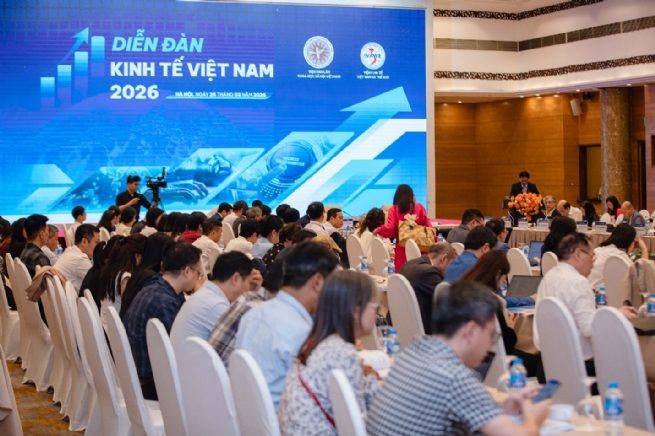
Vietnam is preparing a strategic shift in its growth model, with policymakers and business leaders calling for science, technology and innovation to become the primary engines of future development.
At the Vietnam Economic Forum 2026, organised by the Vietnam Institute of Economics and World Economy under the Vietnam Academy of Social Sciences, Nguyen Duc Hien, Deputy Head of the Party’s Policy and Strategy Commission, said the Politburo has tasked the commission with drafting a new development framework based on science, technology, innovation and digital transformation.
The move comes as Vietnam reassesses its economic trajectory after nearly four decades of reforms. Traditional drivers such as capital investment and low-cost labor are losing effectiveness, while global growth is increasingly fueled by innovation, digital technologies and data.
From the business perspective, Nguyen Trung Chinh, Chairman of CMC Corporation, said Vietnam must urgently establish new growth engines, with the digital economy and AI at the core. He described data as a new “factor of production,” comparable to land, labor and capital.
“Data is the digital workforce and the foundation of innovation,” Chinh said, adding that AI should be treated not just as a technology, but as strategic national infrastructure with economy-wide impact.
Estimates presented at the forum suggest that, if effectively developed, the digital and AI economy could contribute up to 30% of Vietnam’s gross domestic product. By 2030, the sector could reach a value of around $80 billion, driven by productivity gains, the emergence of new industries and the “intelligentization” of economic activities.
AI is also expected to generate exponential growth, with rates ranging from 20% to 30%, and up to 50% in some sectors, providing a foundation for sustained double-digit expansion. International experience shows that economies such as the United States, China and Singapore have achieved significant gains from data- and AI-driven strategies. In Singapore, the data economy accounts for 18.6% of GDP.
However, experts cautioned that institutional reform will be critical to turning these ambitions into reality. Huynh Quyet Thang, President of Hanoi University of Science and Technology, said science, technology and digital transformation must serve as a “cross-cutting axis” of the development model, rather than a supporting component.
He called for more flexible regulatory frameworks, expanded policy experimentation and a shift from a control-oriented approach to a more facilitative and risk-tolerant mindset.
Human capital is another key factor. With a relatively young population, Vietnam has an opportunity to strengthen its workforce, particularly in digital skills and technological capabilities, while accelerating the development of digital infrastructure.
Despite broad agreement on policy direction, implementation remains a major bottleneck. Vu Sy Cuong, Associate Professor at the Academy of Finance, said Vietnam’s spending on science and technology has remained modest, at around 1–2% of the state budget, while total research and development (R&D) expenditure stands at approximately 0.4% of GDP.
Private sector participation is limited, contributing only about 0.2% of GDP, with most spending coming from state-linked enterprises. Complex administrative procedures and risk-averse governance have discouraged businesses from fully utilizing existing incentives.
“We do not lack policies; we lack mechanisms to make them work,” Cuong said.
Dang Xuan Thanh, Vice President of the Vietnam Academy of Social Sciences, said mobilizing resources for science and technology will require a coordinated approach involving the state, businesses and the market. While the government should play a leading role, the private sector must be central in allocating and deploying capital.
Simplifying procedures, reducing compliance costs and accepting managed risks will be essential to unlocking investment and accelerating innovation, he added.
As Vietnam seeks to reposition its growth model, the key challenge will be not only setting priorities, but ensuring effective implementation.
Source: VCCI
Related News

MEMBER CORNER / PROMOTIONS
PEBSTEEL CELEBRATES KEY SUSTAINABILITY MILESTONES AT VSCF 2026
Pebsteel was honored to participate in the Vietnam Sustainable Construction Forum 2026 (VSCF), joining industry experts, businesses, and organizations from Vietnam and around the world to exchange insights and explore solutions for advancing sustainable, low-carbon construction. A highlight of the event was Pebsteel being recognized among the Top 17 Pioneering Companies in Sustainable Construction – Building Materials Category.
MEMBER CORNER / PROMOTIONS
KNIC STRENGTHENS VIETNAM-GREATER BAY AREA INVESTMENT CONNECTIONS THROUGH STRATEGIC MOUS
On 14 July 2026 in Guangdong, KN Industrial City (KNIC) signed Memoranda of Understanding with three influential business and social organisations from the Greater Bay Area and Shenzhen, marking a new step in strengthening investment connections between Vietnam and one of Asia’s most dynamic economic regions.

INFRASTRUCTURE / CONSTRUCTION / LOGISTIC / PORT
VIỆT NAM UPGRADES SEAPORT NETWORK TO STRENGTHEN MARITIME COMPETITIVENESS
Hải Phòng City has emerged as one of Việt Nam's key logistics hubs thanks to an integrated transport network combining expressways, an international airport, a planned high-speed railway and a deep-water port capable of handling vessels of more than 200,000 deadweight tonnages (DWT) with direct connections to Europe and the Americas.

VIETNAM ECONOMY INVESTMENT
VIỆT NAM SEEKS TO EXPAND FRUIT EXPORTS TO CHINA THROUGH QUALITY AND VALUE
Despite strong performance, industry experts said there was still considerable room to expand Việt Nam's fruit and vegetable exports to China. However, they noted that this would depend on Vietnamese producers improving product quality, traceability, processing capacity and logistics to meet China's increasingly stringent import requirements.

INFRASTRUCTURE / CONSTRUCTION / LOGISTIC / PORT
KHÁNH HÒA CALLS FOR INVESTMENT IN PORTS, LOGISTICS
At an investment promotion conference held on July 14, Trương Văn Tiến, director of the provincial Investment, Trade and Tourism Promotion Centre highlighted the strategic advantages of the Vân Phong deep-water port and Cà Ná port, saying the facilities would underpin the development of port services, logistics, shipbuilding, energy and other marine-based industries.
INFRASTRUCTURE / CONSTRUCTION / LOGISTIC / PORT
HUNG YEN BUILDS MOMENTUM FOR DOUBLE-DIGIT GROWTH WITH STRONG H1 PERFORMANCE
Strong industrial output, rising investment and robust trade propelled Hung Yen into Vietnam's top five fastest-growing localities in the first half of 2026, reinforcing confidence in the province's double-digit growth outlook. Accordingly, the Northern province posted regional GDP growth of 10.7 per cent in the first half (H1) of 2026, outperforming its growth target and ranking among Vietnam's five fastest-growing localities.
Events Sponsors


