Want to be in the loop?
subscribe to
our notification
Business News
TRADE REVENUE RISES 22.2% IN JAN–FEB
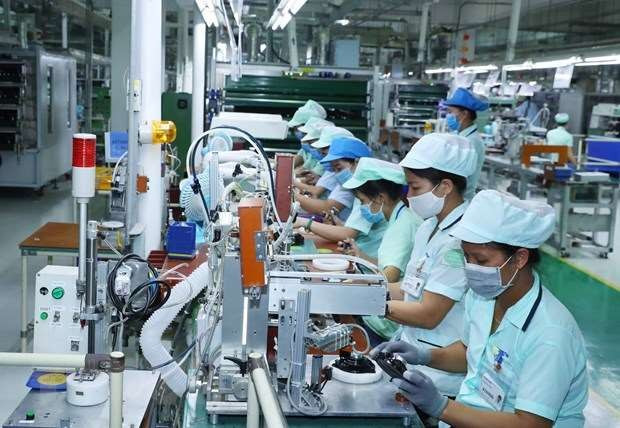
Workers assemble electronic components at a production line in a manufacturing plant in Vietnam - PHOTO: VNA
HCMC – Vietnam’s total import-export revenue reached US$155.7 billion in the first two months of the year, up 22.2% from a year earlier, with a trade deficit of US$2.98 billion, according to the National Statistics Office.
A report released on March 6 showed exports totaled US$76.36 billion in January–February, up 18.3% year-on-year, while imports rose 26.3% to US$79.34 billion.
Foreign-invested enterprises remained the main driver of exports. The sector, including crude oil, recorded US$60.4 billion in export revenue, up 30.1% and accounting for 79.1% of total exports.
Exports from the domestic sector declined 12% year-on-year to US$15.96 billion.
Thirteen export items posted revenue exceeding US$1 billion, accounting for nearly 80% of the country’s total export value. Processed industrial goods made up 89.8% of total exports.
On the import side, production materials accounted for US$74.67 billion, or 94.1% of total imports, reflecting demand for manufacturing inputs.
Imports by the foreign-invested sector rose 42.2%, indicating expansion in investment and production activities.
In February alone, total trade revenue reached US$67.16 billion, down 24.1% from January but 5.1% higher than a year earlier.
The United States remained the largest export market, with shipments estimated at US$23.8 billion. China was the biggest source of imports, valued at US$31.9 billion.
Faster import growth pushed the trade balance into deficit in the first two months of 2026, compared with a surplus of US$1.77 billion in the same period last year.
The domestic sector posted a trade deficit of US$6.5 billion, while the foreign-invested sector recorded a trade surplus of US$3.52 billion.
Source: The Saigon Times
Related News

MEMBER CORNER / PROMOTIONS
VIETNAM RISING STAR: CONNECTING GLOBAL CAPITAL TO VIETNAM'S HIGH-GROWTH FRONTIERS
Vietnam stands at a pivotal inflection point as global supply chains reconfigure and capital seeks resilient, innovation-driven markets. HKBAV is proud to support the exclusive Inbound Investment Forum "Vietnam Rising Star: Connecting Global Capital to Vietnam's High-Growth Frontiers", bringing together global investors, corporate decision-makers, and financial experts to unlock the next wave of foreign direct investment and strategic M&A opportunities in Vietnam!

MEMBER CORNER / PROMOTIONS
VIETNAM GO GLOBAL: MASTERING OUTBOUND INVESTMENTS & EXPANSION FROM LOCAL TO GLOBAL
Vietnamese enterprises are increasingly looking beyond domestic borders to scale on the international stage. HKBAV is proud to support the exclusive Outbound Investment Forum "Vietnam Go Global - Mastering Outbound Investments & Expansion from Local to Global", bringing together influential corporate decision-makers, global investors, and financial experts to navigate the practicalities of cross-border expansion!

MEMBER CORNER / PROMOTIONS
VIETNAM'S MANUFACTURING STORY HAS CHANGED IN 2026
Vietnam is no longer attracting investment solely because of its competitive costs. Today, global manufacturers are increasingly choosing Vietnam for its expanding industrial ecosystem, resilient supply chains and growing role in high-value sectors such as semiconductors, electronics and advanced manufacturing.

VIETNAM ECONOMY INVESTMENT
VIỆT NAM STEPS UP EXPORT TO ACHIEVE US$550-BILLION TARGET
Việt Nam is intensifying efforts to sustain export momentum in the second half of 2026 as the country works towards its target of US$550 billion in export revenue for the year, despite continuing uncertainties in global trade. Statistics show that exports reached $266.5 billion in the first six months, meaning the economy needs to generate around $245.5 billion more during the remainder of the year to meet the annual goal.

VIETNAM ECONOMY INVESTMENT
ASIA POWERS VIETNAM’S SHRIMP BOOM, LEAVING THE WEST BEHIND
In the first half of 2026, Vietnam's shrimp exports surpassed the US$2.3 billion mark, driven largely by booming demand from China and a lobster craze. But behind that growth figure lies a lopsided picture: Asia is carrying the load, while the U.S. and Europe have yet to break out. These days, a container of frozen shrimp leaving a Ho Chi Minh City port is more likely to cross the East Vietnam Sea to Shanghai than the Pacific to Los Angeles.

VIETNAM ECONOMY INVESTMENT
CHINESE INVESTMENT WAVE OPENS NEW DOORS
As Chinese companies move beyond factory relocation to ecosystem-driven investment, Vietnam has a rare opportunity to evolve from a low-cost production base into a strategic node in regional value chains. When global companies first diversified supply chains, the focus was largely on relocating manufacturing capacity.
Events Sponsors


