Want to be in the loop?
subscribe to
our notification
Business News
FREE TRADE AGREEMENTS GIVE VIỆT NAM’S EXPORTS POWERFUL BOOST
According to the Ministry of Industry and Trade, as of July this year, more than 1.2 million certificates of origin (C/Os) had been issued under various FTAs, covering exports worth nearly US$100 billion, equivalent to 28 per cent of Việt Nam’s total export value.
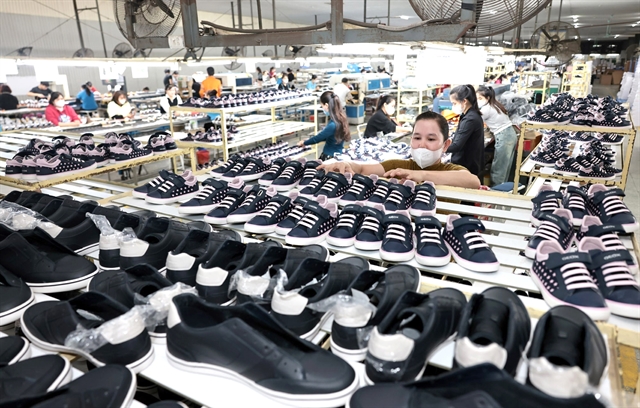
Shoes are key export goods from Việt Nam to the EU. Total two-way trade between Việt Nam and the EU from January 1995 to June 2026 surpassed US$900 billion. VNA/VNS Photo
HÀ NỘI — The effective use of new-generation free trade agreements (FTAs) has enabled Vietnamese businesses to expand into new markets, strengthen their competitiveness and integrate more deeply into global value chains.
According to the Ministry of Industry and Trade, as of July this year, more than 1.2 million certificates of origin (C/Os) had been issued under various FTAs, covering exports worth nearly US$100 billion, equivalent to 28 per cent of Việt Nam’s total export value.
The utilisation rate of FTA tariff preferences remains high, with some agreements, such as the EU-Việt Nam Free Trade Agreement (EVFTA), the ASEAN-India FTA, and the ASEAN-Australia-New Zealand FTA, recording rates of 30-50 per cent.
More than $383 billion generated in six years
Statistics from the Ministry of Finance show that total two-way trade between Việt Nam and the EU from January 1995 to June 2026 surpassed $900 billion.
Notably, $383.8 billion, or 42.6 per cent of the total, was generated during just the first six years of implementing the EVFTA from 2020 to 2026.
In the first half of this year alone, bilateral trade reached $41.4 billion, with Việt Nam exporting $31.8 billion to the bloc. The country posted a record trade surplus of $22 billion in the period, exceeding the $21.7 billion surplus recorded for the whole of 2019, before the EVFTA came into force.
According to a recent survey by the European Chamber of Commerce in Việt Nam (EuroCham), 50 per cent of EU businesses operating in Việt Nam reported benefiting directly from EVFTA tariff preferences, while 66 per cent said they had reduced costs by 5-30 per cent. Some European companies noted that more than 80 per cent of Vietnam-EU trade now qualifies for preferential tariffs, lowering product costs by 5-15 per cent and improving market competitiveness.
Beyond the EVFTA, many Vietnamese companies are also optimising other new-generation FTAs, including the Comprehensive and Progressive Agreement for Trans-Pacific Partnership (CPTPP), the Regional Comprehensive Economic Partnership (RCEP) and the Vietnam-Korea Free Trade Agreement (VKFTA), to diversify markets and deepen participation in global supply chains.
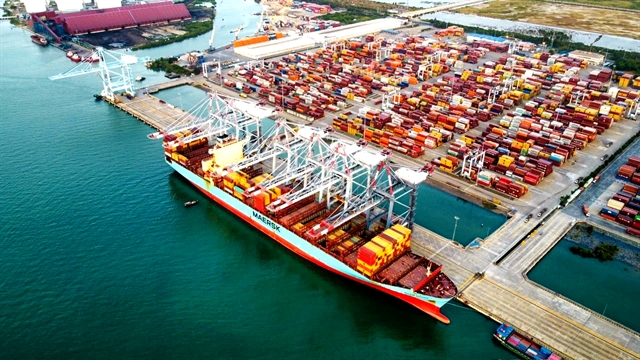
Cái Mép International Port. With preferential tariffs now available, Vietnamese companies could process products domestically and export them directly to Japan. Photo danviet.vn
Huỳnh Minh Tường, deputy general director of Bà Rịa - Vũng Tàu Seafood Processing And Import-Export JSC (BASEAFOOD), said that before the Vietnam-Japan FTA took effect, part of local seafood exports was shipped to China for processing before being re-exported to Japan. With preferential tariffs now available, Vietnamese companies could process products domestically and export them directly to Japan, significantly enhancing competitiveness. As a result, BASEAFOOD's exports to Japan had increased by 30-40 per cent.
Similarly, Minh Phu Seafood Corporation has used the CPTPP to expand shrimp exports to Canada, Japan and Australia, while Vinh Hoan Corporation has increased its Tra fish market share in Canada and other CPTPP members.
Lộc Trời Group has expanded rice exports to Asian markets, particularly China and ASEAN countries, by taking advantage of the CPTPP's flexible rules of origin and streamlined procedures. Vinamilk has utilised the VKFTA and ASEAN FTAs to boost dairy exports to the Republic of Korea, the Philippines, Singapore and other regional markets. Hòa Phát Group has increased steel exports across the Asia-Pacific while using regional raw materials to satisfy RCEP rules of origin. Meanwhile, Vinatex has secured more orders from Canada, Australia and New Zealand under the CPTPP and invested in an integrated fibre-weaving-dyeing supply chain to comply with origin requirements.
Considerable untapped potential remains
Assessing Việt Nam’s FTA performance, Nguyễn Lý Trường An, a trade expert at Long An University of Economics and Industry, said businesses' ability to utilise FTAs remained uneven.
Large enterprises with stronger management capacity, advanced technology and well-developed supply chains generally benefited more, while many small- and medium-sized ones continued to face difficulties accessing information, mobilising resources and meeting the stringent standards of export markets.
"The effectiveness of FTA utilisation depends heavily on business leaders' awareness and strategic vision," An said. "Some companies have achieved remarkable growth by proactively taking advantage of these agreements, while others have missed valuable opportunities despite having similar resources.”
"FTAs are not simply about tariff reductions; they are a catalyst for them to restructure production, enhance competitiveness, and integrate more deeply into global value chains," he noted.
From a broader perspective, Associate Professor Nguyễn Thường Lạng from the National Economics University’s Institute of Trade and International Economics, said FTAs were not only a powerful driver of exports but also an important catalyst for restructuring Việt Nam’s economy.
According to the expert, if Việt Nam fully capitalises on its FTA commitments, it will expand its development opportunities, attract higher-quality investment and become more appealing to international investors. At the same time, it will strengthen domestic production capacity and enhance the global standing of Vietnamese products.
“This is the key to creating new growth momentum at a time of intensifying international trade competition," he said. — VNA/VNS
Source: VNS
Related News

CHARITY / EXHIBITION / OTHER EVENTS
INVESTMENT OPPORTUNITIES IN CA MAU PROVINCE: 96 PROJECTS AND 20 STRATEGIC PROJECTS
We are pleased to share with you information on investment projects currently seeking investors in Ca Mau Province. Should your esteemed company or association be interested, we kindly invite you to review the project information and complete the registration form via the links provided. The Ho Chi Minh City Investment and Trade Promotion Centre (ITPC) will consolidate the expressions of interest and facilitate connections with the leadership of Ca Mau Province at a meeting tentatively scheduled for 13 November 2026 in Ho Chi Minh City.

MEMBER CORNER / PROMOTIONS
BẰNG KIỀU LIVESHOW - A SYMPHONY OF LOVE UNDER THE GOLDEN GLOW
A masterclass in live music that takes the audience on a soulful journey through immortal love songs, guided by the peerless artistry and emotive storytelling of renowned singer Bằng Kiều. The highlight of the night is his seamless musical chemistry with special guest Triệu Hồng Ngọc, promising passionate and deeply resonant duets inside the magnificent Grand Ballroom.

INFRASTRUCTURE / CONSTRUCTION / LOGISTIC / PORT
ĐÀ NẴNG GREEN-LIGHTS US$105 MILLION THAI DEVELOPMENT DEAL
The central city has approved an investment proposal by Thailand’s WHA Group to develop infrastructure for the 400ha WHA Đà Nẵng Industrial Park project on two communes of Thăng Bình and Đồng Dương, with an investment of more than VNĐ2.7 trillion (US$105 million). The city said it approved WHA Industrial Development International's status as an investor in the project, which is expected to take place between 2027 and 2034.

VIETNAM ECONOMY INVESTMENT
MOBILE PHONE EXPORTS RISE 20% TO $51.8 BILLION IN FIRST NINE MONTHS
Exports of mobile phones and components rose 20 per cent year-on-year to nearly US$51.8 billion in the first nine months of 2026, with China, the US and Republic of Korea accounting for more than half of the total. Shipments to the three markets reached a combined $26.18 billion, or 50.6 per cent of total exports of the product group during the period, according to data from the Vietnam Department of Customs under the Ministry of Finance.

INFRASTRUCTURE / CONSTRUCTION / LOGISTIC / PORT
VIỆT NAM-CAMBODIA TRADE GATHERS PACE TOWARDS $20 BILLION TARGET
Trade between Việt Nam and Cambodia continues to grow, remaining a bright spot and a key pillar of bilateral cooperation as the two countries aim to raise two-way trade to US$20 billion in the coming years. After setting a record of more than $11.3 billion last year, bilateral trade reached about $8.7 billion in the first eight months of this year, up 8.3 per cent year on year.

VIETNAM ECONOMY INVESTMENT
FRUIT AND VEGETABLE EXPORTS POISED TO HIT $10 BILLION IN 2026
Fruit and vegetable exports are on track to reach nearly US$10 billion in 2026, after rising 19.9 per cent year on year to nearly US$7.4 billion in the first nine months, driven by strong seasonal demand and abundant tropical fruit supplies. The Ministry of Agriculture and Environment said the growth reflected stronger international demand for fresh produce and processed agricultural products.
Events Sponsors






















