Want to be in the loop?
subscribe to
our notification
Business News
EUROPEAN BUSINESS CONFIDENCE IN VIETNAM SURGED IN SECOND QUARTER
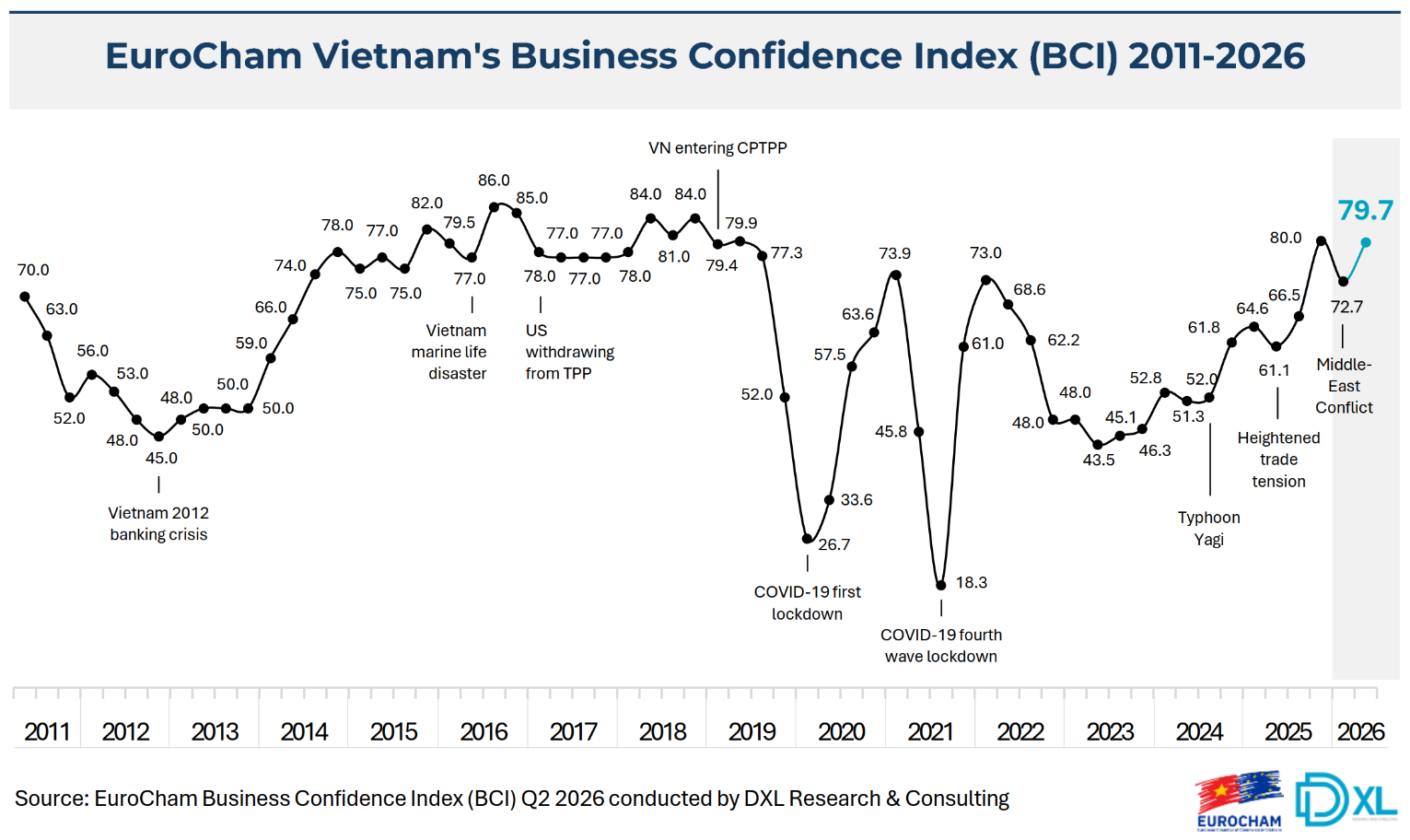
Defying global supply chain volatility and shifting trade dynamics, European business confidence in Vietnam has surged to 79.7 points in the second quarter of 2026, underscoring Vietnam's resilience amid one of the most volatile global operating environments in recent years.
Marking the 15-year anniversary of the European Chamber of Commerce in Vietnam (EuroCham) flagship Business Confidence Index (BCI), the second-quarter report reveals a renewed surge in European business confidence.
With a sharp seven-point climb from the 72.7 points recorded in the first quarter, this quarter’s index is just a fraction below the historic seven-year peak of 80 reached in late 2025. The momentum signals a renewed appetite among European investors for expansion in one of Southeast Asia's fastest-growing economies, reaffirming the long-term confidence that briefly receded amid heightened global uncertainty.
"This quarter's findings demonstrate the incredible, almost tenacious resilience of both Vietnam's economy and the European businesses operating here," said Bruno Jaspaert, chairman of EuroCham. "The first half of 2026 has been a rollercoaster. We entered the year with complex geopolitical wild cards, yet, despite a heavy cloud of global uncertainty, our member companies outperformed their own expectations. This index proves that when the weather gets rough, our ecosystem knows how to recalibrate and capture growth."
Conducted in partnership with DXL Research and Consulting, this edition provides one of EuroCham's most comprehensive assessments yet of how European businesses are responding to an increasingly complex global and local environment. Beyond measuring business sentiments, the BCI examines the impact of geopolitical tensions, evolving trade dynamics, administrative reform and intellectual property protection.
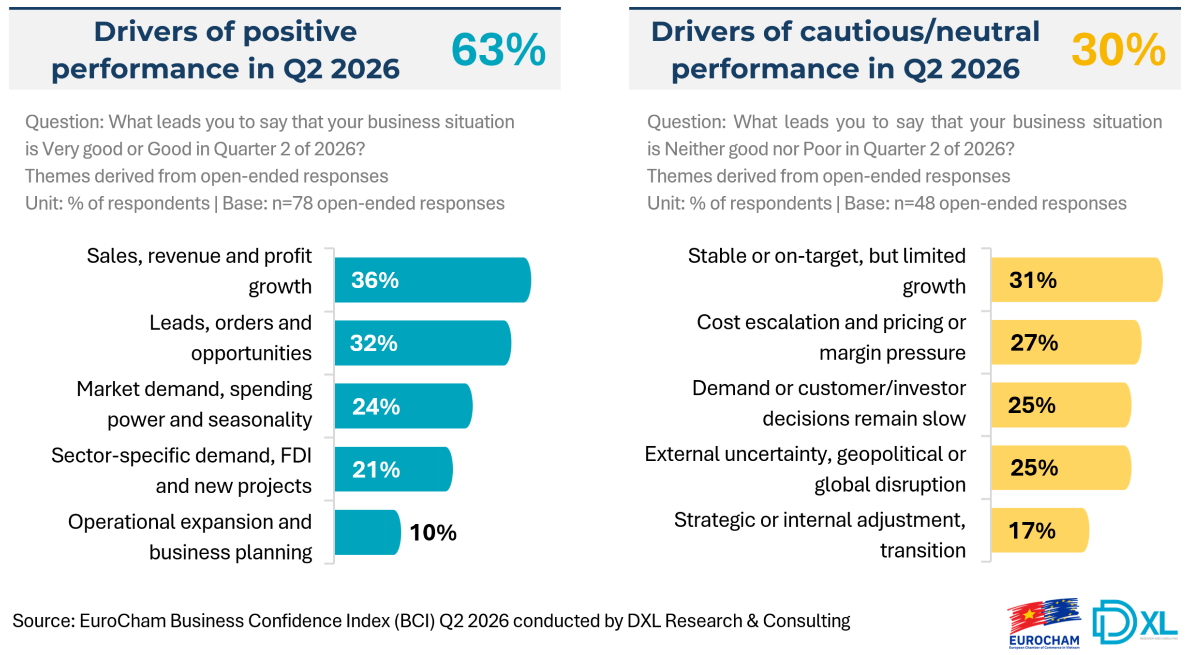
The survey shows that 63 per cent of European businesses reported positive business conditions during the second quarter, while optimism continues to strengthen, with 69 per cent expecting improvements in the coming quarter. This wave of optimism represents an 11-percentage-point jump compared to the expectations expressed just three months ago, driven by surging commercial performance, a healthy influx of new orders, and resilient domestic demand.
According to Xavier Depouilly, general manager of DXL Research and Consulting, “Confidence has recovered across all sectors, confirming that the slowdown recorded in the first quarter was broad-based but ultimately temporary. While the pace of recovery has varied by industry, the overall direction is consistent.”
He added that agrifood recorded a more modest 5.5-point improvement, whereas Tourism and Hospitality surged by 8.7 points to reach 90.4, well above the overall index. Across industries, businesses have outperformed their own expectations, supported by resilient domestic and international demand, expanded public and private investment, and a remarkable ability to adapt to an increasingly complex environment. By introducing sector and company size level analysis, the BCI report and dashboard now provide a more granular understanding of business sentiment, helping both investors and policymakers identify where confidence is strengthening, where challenges remain, and where targeted actions can have the greatest impact.
The data highlights clear commercial drivers behind this optimism. Among the firms reporting improved performance this quarter, 36 per cent pointed to rising revenues, stronger sales velocities, and enhanced operational profitability that consistently outpaced internal forecasts. Meanwhile, 32 per cent credited their brighter outlook to expanding order books and major new contract wins, while 24 per cent reported a noticeable strengthening in domestic consumer demand. This balanced growth across manufacturing, tourism, real estate, and export-oriented sectors shows that Vietnam’s economic engine is accelerating on multiple cylinders.
"These BCI results mirror the broader macroeconomic landscape as Vietnam solidifies its position as one of Asia's growth champions," chairman Jaspaert explained. "In the first half of 2026 alone, the national GDP expanded by an impressive 8.18 per cent. When you pair that breakneck growth with Vietnam's rise to 27th in the IMD World Competitiveness Ranking and its upcoming FTSE Russell upgrade to a secondary emerging market this September, the narrative is crystal clear. What makes Vietnam truly stand out in a fiercely competitive regional landscape is a government that does not just talk about growth, but formalises it into national resolutions and actively executes structural reforms to pursue it."
Throughout 2026, the government has accelerated institutional reforms, administrative restructuring and investment policies aimed at attracting higher-quality foreign direct investment. Chief among these is the recent rollout of Resolution 10, which shifts the country's foreign investment criteria away from cheap labour and raw volume towards high-tech innovation, technology and sustainable growth.
EuroCham has remained an active partner throughout this legislative evolution. During the chamber’s flagship Whitebook Dialogue Week in Hanoi in May, the chamber's leadership engaged directly with Vietnamese government, ministries, the State Bank of Vietnam, and the National Assembly to advance practical solutions across diverse sectors. This continuous public-private feedback loop ensures that the operational insights of European business are woven into the fabric of Vietnam's next economic chapter.
However, this wave of optimism comes with an operational caveat: strong internal performance cannot offset a burdensome regulatory framework. If Vietnam wants to convert today's positive sentiment into tomorrow's megaprojects, it must tackle its administrative bottlenecks head-on.
As a response, the government has introduced several important reforms during 2026 to strengthen Vietnam's intellectual property framework and intensify enforcement against counterfeiting and trademark infringement. While businesses broadly welcome these measures, many noted that it remains too early to assess their practical impact, highlighting the importance of effective implementation alongside legislative reform.
Taken together, the findings point to a consistent message from the European business community: Vietnam's economic fundamentals remain highly attractive, but administrative reform now represents the single greatest opportunity to strengthen competitiveness further.
"As our businesses become more sophisticated, they require an equally sophisticated regulatory environment," said Jaspaert. "Predictable regulations, efficient administration, and uniform enforcement are what keep investment capital secure. The more-than 80 new and amended laws introduced this year alone mark the beginning of an intensive growth era. EuroCham’s role is to serve as the steady bridge connecting on-the-ground business insights with policymakers, ensuring these reforms can be translated into businesses' confidence to anchor here for the long term."
Source: VIR
Related News

CHARITY / EXHIBITION / OTHER EVENTS
INVESTMENT OPPORTUNITIES IN CA MAU PROVINCE: 96 PROJECTS AND 20 STRATEGIC PROJECTS
We are pleased to share with you information on investment projects currently seeking investors in Ca Mau Province. Should your esteemed company or association be interested, we kindly invite you to review the project information and complete the registration form via the links provided. The Ho Chi Minh City Investment and Trade Promotion Centre (ITPC) will consolidate the expressions of interest and facilitate connections with the leadership of Ca Mau Province at a meeting tentatively scheduled for 13 November 2026 in Ho Chi Minh City.

MEMBER CORNER / PROMOTIONS
BẰNG KIỀU LIVESHOW - A SYMPHONY OF LOVE UNDER THE GOLDEN GLOW
A masterclass in live music that takes the audience on a soulful journey through immortal love songs, guided by the peerless artistry and emotive storytelling of renowned singer Bằng Kiều. The highlight of the night is his seamless musical chemistry with special guest Triệu Hồng Ngọc, promising passionate and deeply resonant duets inside the magnificent Grand Ballroom.
INFRASTRUCTURE / CONSTRUCTION / LOGISTIC / PORT
ĐÀ NẴNG GREEN-LIGHTS US$105 MILLION THAI DEVELOPMENT DEAL
The central city has approved an investment proposal by Thailand’s WHA Group to develop infrastructure for the 400ha WHA Đà Nẵng Industrial Park project on two communes of Thăng Bình and Đồng Dương, with an investment of more than VNĐ2.7 trillion (US$105 million). The city said it approved WHA Industrial Development International's status as an investor in the project, which is expected to take place between 2027 and 2034.
VIETNAM ECONOMY INVESTMENT
MOBILE PHONE EXPORTS RISE 20% TO $51.8 BILLION IN FIRST NINE MONTHS
Exports of mobile phones and components rose 20 per cent year-on-year to nearly US$51.8 billion in the first nine months of 2026, with China, the US and Republic of Korea accounting for more than half of the total. Shipments to the three markets reached a combined $26.18 billion, or 50.6 per cent of total exports of the product group during the period, according to data from the Vietnam Department of Customs under the Ministry of Finance.

INFRASTRUCTURE / CONSTRUCTION / LOGISTIC / PORT
VIỆT NAM-CAMBODIA TRADE GATHERS PACE TOWARDS $20 BILLION TARGET
Trade between Việt Nam and Cambodia continues to grow, remaining a bright spot and a key pillar of bilateral cooperation as the two countries aim to raise two-way trade to US$20 billion in the coming years. After setting a record of more than $11.3 billion last year, bilateral trade reached about $8.7 billion in the first eight months of this year, up 8.3 per cent year on year.
VIETNAM ECONOMY INVESTMENT
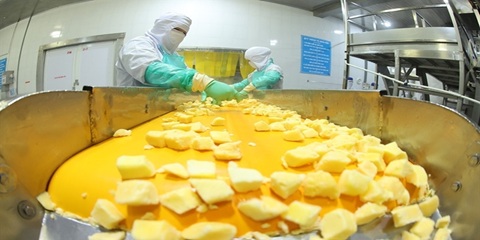
FRUIT AND VEGETABLE EXPORTS POISED TO HIT $10 BILLION IN 2026
Fruit and vegetable exports are on track to reach nearly US$10 billion in 2026, after rising 19.9 per cent year on year to nearly US$7.4 billion in the first nine months, driven by strong seasonal demand and abundant tropical fruit supplies. The Ministry of Agriculture and Environment said the growth reflected stronger international demand for fresh produce and processed agricultural products.
Events Sponsors






















